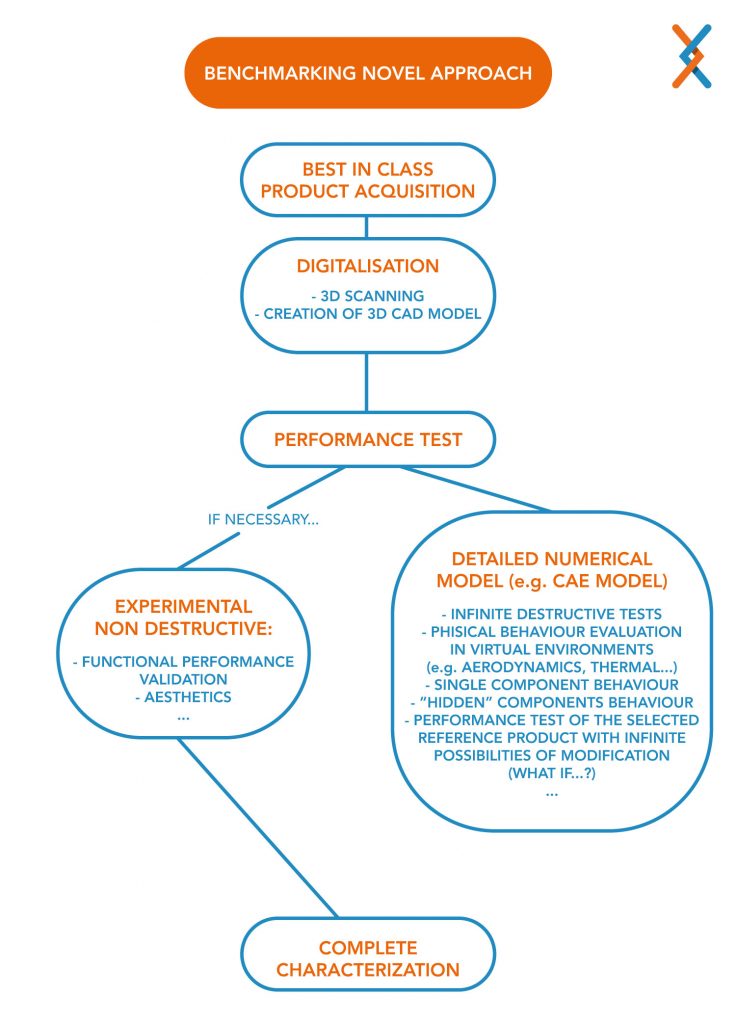
Test your competitors' products with a large number of repetitions without the need for a physical model, but characterise them fully using a mathematical model.
Focus on a subset of components or a single component of interest, and try out possible variants without the limitations imposed by experimental testing alone.
Use our Product Virtual Benchmarking method to limit the costs associated with experimental testing and the related infrastructure.
Virtual Benchmarking is now used by the best automotive manufacturers.
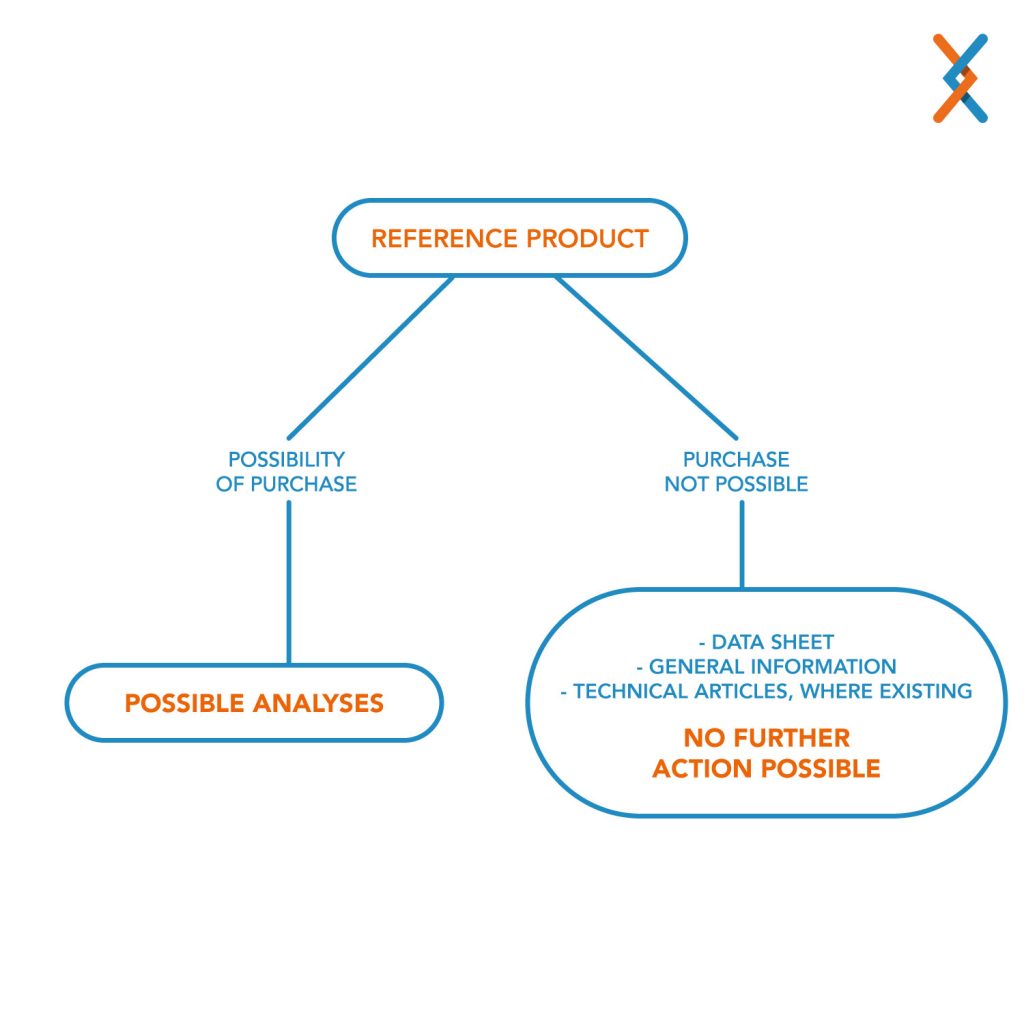
Imagine, for example, having to assess the passive safety performance of a car through an experimental crash test. When the competitor’s reference car is available on the market, three main problems immediately arise:
1) The cost of sufficient cars on which to carry out testing
2) It is difficult to understanding the “isolated” behaviour of a component within a single test.
3) It is impossible to test variants of the solutions that the competitor has already established.
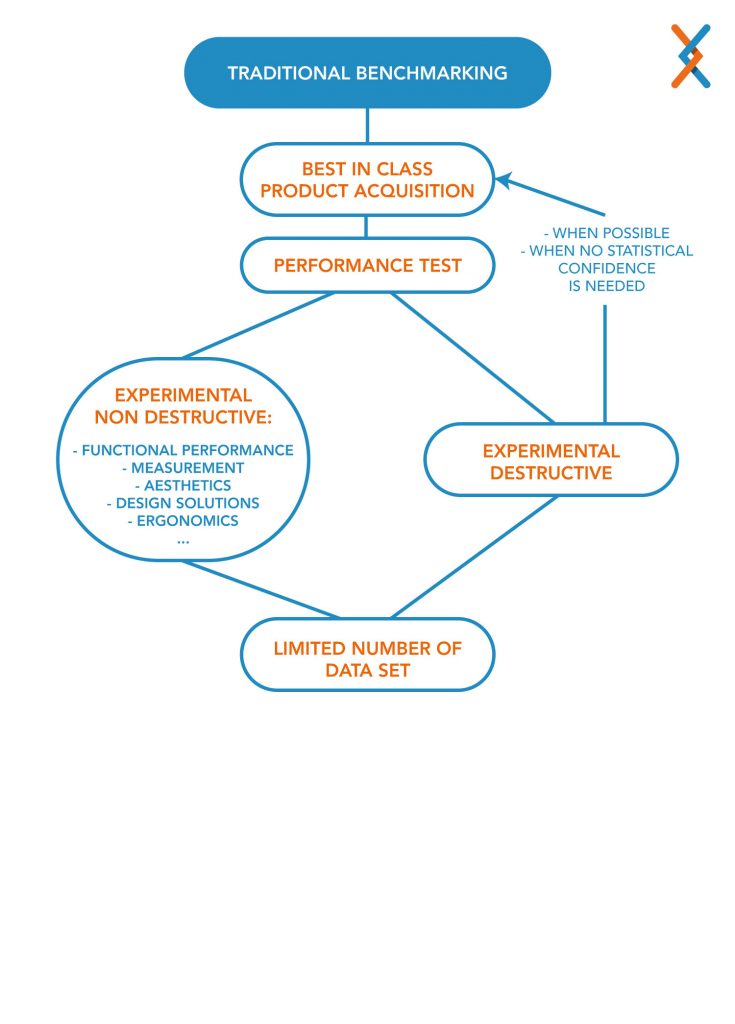
Summary description of the conventional approach compared to the AXIRO method.
Reference products affect the choices made by the designer, who assesses the work done by other designers either positively or negatively, and in turn chooses solutions that can best meet the requirements.
Where possible, competitors’ “best in class” products should be analysed with various methods that tend to record performance in as much detail as possible.
AXIRO has decades of design experience, which has highlighted two rather particular aspects:
– In some cases, either because of very tight product development times or because of the need to do something different from the competitors at any cost, the designer does not pay enough attention to analysing the state of the art in a truly detailed manner.
– The second one is that, in most cases, the analysis is only carried out experimentally using functional, destructive and non-destructive testing.
AXIRO proposes analysing the performance of competitors’ products by systematically applying an approach that is almost completely new in many industrial fields, Virtual Benchmarking.
As already mentioned, the range of applications for Virtual Benchmarking starts from automotive, passes through the consumer goods sector, and extends to machinery and any fields in which “best in class” products are available from competitors and can be used as a basis for improvement.
Via Ignazio Silone 81
24059 Urgnano BG, Italy
+ 39 035 315 165